
Our services
Lab, field and ground investigations
Four service areas, one team. Choose a section, or tell us about your project and we'll put the right tests together.
Laboratory
Soil & gravel testing
Before a material goes into a road layer, an embankment or a building platform, you need to know how it behaves. Our laboratory tests tell you how a soil or gravel is graded, how it reacts to water, how dense it can be compacted and how much load it can carry, and how it compares with the class your design calls for.
Grading (sieve analysis)
The spread of particle sizes, from stone down to fines.
Atterberg limits & linear shrinkage
Plasticity: how the fines behave when wet, and how much they shrink.
Mod AASHTO (MDD / OMC)
The highest density a material reaches, and the moisture it needs to get there.
CBR
Bearing strength at different densities, used to classify road materials.
Road & foundation indicators
Grouped tests to classify materials for road layers and to flag problem soils.
Stabilised materials (UCS / ITS)
Strength of cement- or lime-treated layers against the design requirement.
Typical methods: SANS 3001 (GR series), TMH1, with materials classified for road layers in line with TRH14 / COLTO.
On site
Field density & DCP
A layer is only as good as its compaction. Our technicians test each layer where it is built, compare the result with the laboratory density, and tell you on the day whether it meets the specification. That way the next layer can follow without delay.
- Nuclear density gauge: fast density and moisture readings on site.
- Sand replacement: the traditional in-place density test, also used to check gauge readings.
- DCP (dynamic cone penetrometer): a quick strength profile of existing roads, subgrades and foundations.
- Sampling: layer and stockpile samples taken correctly and brought to the laboratory.
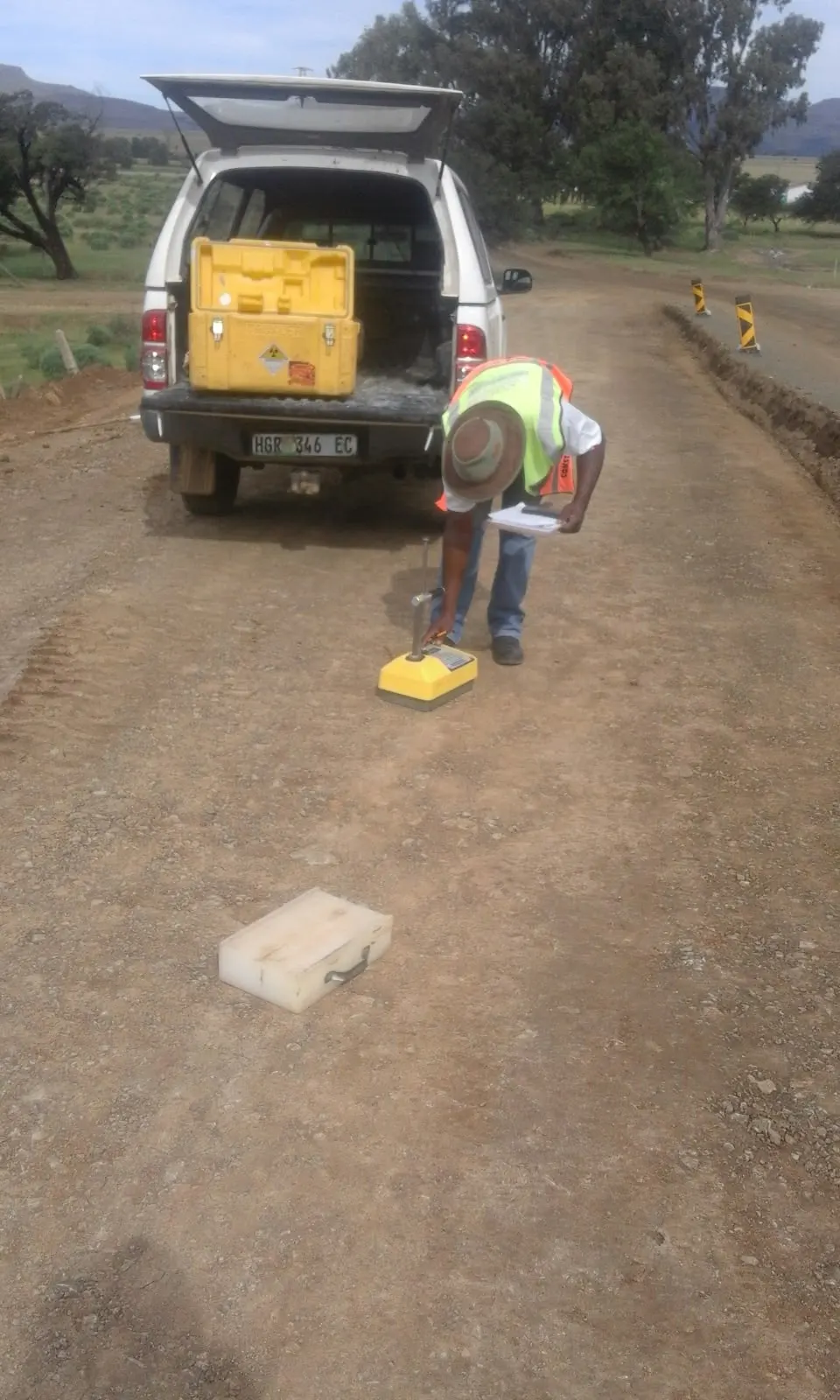
Typical methods: SANS 3001 (NG series), TMH1 sand replacement, TMH6 for DCP, and TMH5 for sampling.
Laboratory & site
Concrete & aggregates
From the stone at the quarry to the concrete in the slab, we check that what you ordered is what you got. We sample concrete as it is delivered, make and cure cubes, crush them at the required ages, and test aggregates before they go into concrete, asphalt or road bases.
Concrete
- Sampling fresh concrete on site
- Slump test
- Making and curing cubes
- Cube crushing (compressive strength)
- Cores from hardened concrete
Aggregates
- Grading of stone and sand
- Flakiness and particle shape
- Crushing strength (ACV / 10% FACT)
- Fines and cleanliness
Typical methods: SANS 5861, 5862, 5863 and 5865 for concrete, and SANS 3001 (AG series) for aggregates.
Investigations
Geotechnical & road investigations
Good design starts with knowing the ground. We dig, log and sample to show you what is underneath a site or along a road, find materials you can use, and flag problem soils early, while changes are still cheap.
Test pits & soil profiling
Pits dug and logged layer by layer, with samples for testing.
Foundation investigations
Ground conditions for houses, schools, clinics and other structures.
Borrow pit investigations
Locating and proving gravel sources: how much there is and how good it is.
Centreline investigations
Testing the ground along a new or existing road to support pavement design.
Typical approach: soil profiles logged to recognised South African guidelines, with laboratory testing as above. Each investigation is scoped to your project.
The methods listed are the ones most commonly used. We confirm the exact test methods for your project specification when we quote.
Layer ready for testing?
Tell us where and when. We'll get a technician to site.